By Albert Juncà
Today is NBA Draft Day. As in previous years, the draft will be divided into two days, with the first round taking place on June 23rd and the second round on June 24th.
In this article, our Director of Scouting, Albert Juncà, takes a look at some European prospects who could hear their names called in this year’s draft. Some are coming from the NCAA, while others are making the jump directly from Europe.
Aday Mara - Spain - 7’3” - Big - Michigan Wolverines
After spending the first two years of his college career at UCLA, the Spanish center found the minutes and role he was looking for last summer when the Michigan Wolverines recruited him. This past season, Mara played a major role in the Wolverines’ journey to the national championship, increasing his numbers from 6.4 points and 59.0% FG to 12.1 points and 66.8% FG.
More than the numbers, Mara can bring an immediate impact to the league thanks to his size and ability to affect the game in multiple ways. In post-up situations, his appealing mix of above-average size and footwork allows him to find the correct angle to the rim. As a screener in pick-and-roll situations, he also has a great feel for positioning himself to seal defenders in the paint, even when he does not receive the ball on the roll. Over the past two seasons, he has also shown flashes of passing ability from the post and the elbow, using the attention he draws when he gets the ball to find open teammates or feed cutters.
Despite the significant improvement in his body over the past season, he should continue developing his frame to get stronger and compete more consistently through contact in the paint.
Defensively, he has a great feel for executing drop coverages in pick-and-roll situations, relying on his length to cover ground extremely well and allowing his teammates to recover to the ball without losing track of the roller. He is a real shot-changer around the rim, using his standing reach to alter opponents’ shots.
Hannes Steinbach - Germany - 6’11” - Big - Washington Huskies
Alongside his freshman season at Washington, Steinbach has been one of the biggest eye-catchers in the college basketball landscape. He averaged a double-double in 30 games, posting 18.5 points and 11.8 rebounds per game.
With the Huskies, the German big has played in a double-big system, operating at both the 4 and 5 positions. His motor allows him to play intensely as a rim runner. In addition, he is a versatile screener who can punish defenses both as a roller and a popper. Especially in pick-and-pop situations, he has shown improvement as a spot-up shooter with his feet set, but he can also use those situations to create an advantage and attack the basket from the perimeter, relying on his mobility and strength to find his way to the rim.
This versatility and ability to impact the game in multiple situations can be a valuable tool for his NBA career, particularly because of his impressive rebounding ability. He reads the trajectory of the ball extremely well and is capable of starting the break himself, either off the dribble or with outlet passes.
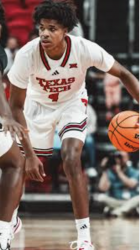
Christian Anderson Jr - Germany/USA - 6’3” - G - Texas Tech Red Riders
Christian Anderson Jr. had a major impact during his sophomore season with the Red Raiders. His numbers increased in most statistical categories, going from 10.6 points, 3.0 rebounds, and 2.2 assists per game as a freshman to 18.5 points, 3.6 rebounds, and 7.4 assists, while shooting an impressive 41.5% from beyond the arc.
The German guard has evolved into a more complete player and not just a scorer. His ability to operate in pick-and-roll situations and rise up for pull-up threes allows him to read the floor effectively, finding open teammates or the roll man against aggressive defensive schemes.
One of the main concerns throughout his youth career has been whether his archetype and size would allow him to translate his game effectively to higher levels. However, throughout European tournaments and World Cups, he consistently stood out as one of the top scorers, showing that he has both the skill set and the creativity to get to the rim, finish against bigger players, and create opportunities for teammates when collapsing the defense.
Sergio De Larrea - Spain - 6’6” - G - Valencia Basket (Spain)
The Valencia Basket guard has played his best season so far since becoming a professional player in Spain. He started the season by being named MVP of the Spanish Supercup, averaging 18 points and 20 efficiency points throughout the tournament. During the season, he averaged 18.1 minutes per game in the ACB and 14.7 minutes across all competitions, becoming an important piece in Valencia’s rotation.
His appealing mix of size and skill set makes him a very interesting prospect at the point guard position. He can play in multiple registers, being able to speed up the game by pushing the break and relying on his long strides to attack all the way to the basket, or slow the pace down and operate in half-court situations. He has a great feel for pick-and-roll situations, reading the defense effectively and making the correct decisions. One of his main strengths is that he does not take unnecessary risks with the ball, securing possessions through smart passing and consistent spot-up shooting.
On the other end, his above-average size makes him a difficult guard to attack. He uses his length to be an active on-ball defender, applying constant pressure. Off the ball, he also shows impressive positioning, staying active and using his length to cover gaps and recover to his man very quickly.
Baba Miller - Spain - 6’11” - Big - Cincinnati Bearcats
Miller entered the NBA Draft after four years in college basketball: two at Florida State, one at FAU, and his senior year at Cincinnati. Throughout this journey, he played in multiple roles and situations, making different levels of impact each season.
His combination of size and mobility makes him a unique player who still has significant room to develop physically. He is a long-term project with very promising physical upside, combined with a broad skill set and versatility at his position.
With the Bearcats, he saw an increase in on-ball responsibilities, looking more comfortable facing up from the perimeter and attacking slower defenders. As a result, he did not find the same type of perimeter shots he had at FAU, which contributed to a drop in his three-point percentage. Despite this, his ability to stretch the floor is still there and remains a skill that can continue to develop during his first years in the league.
Today is NBA Draft Day. As in previous years, the draft will be divided into two days, with the first round taking place on June 23rd and the second round on June 24th.
In this article, our Director of Scouting, Albert Juncà, takes a look at some European prospects who could hear their names called in this year’s draft. Some are coming from the NCAA, while others are making the jump directly from Europe.
Aday Mara - Spain - 7’3” - Big - Michigan Wolverines
After spending the first two years of his college career at UCLA, the Spanish center found the minutes and role he was looking for last summer when the Michigan Wolverines recruited him. This past season, Mara played a major role in the Wolverines’ journey to the national championship, increasing his numbers from 6.4 points and 59.0% FG to 12.1 points and 66.8% FG.
More than the numbers, Mara can bring an immediate impact to the league thanks to his size and ability to affect the game in multiple ways. In post-up situations, his appealing mix of above-average size and footwork allows him to find the correct angle to the rim. As a screener in pick-and-roll situations, he also has a great feel for positioning himself to seal defenders in the paint, even when he does not receive the ball on the roll. Over the past two seasons, he has also shown flashes of passing ability from the post and the elbow, using the attention he draws when he gets the ball to find open teammates or feed cutters.
Despite the significant improvement in his body over the past season, he should continue developing his frame to get stronger and compete more consistently through contact in the paint.
Defensively, he has a great feel for executing drop coverages in pick-and-roll situations, relying on his length to cover ground extremely well and allowing his teammates to recover to the ball without losing track of the roller. He is a real shot-changer around the rim, using his standing reach to alter opponents’ shots.
Hannes Steinbach - Germany - 6’11” - Big - Washington Huskies
Alongside his freshman season at Washington, Steinbach has been one of the biggest eye-catchers in the college basketball landscape. He averaged a double-double in 30 games, posting 18.5 points and 11.8 rebounds per game.
With the Huskies, the German big has played in a double-big system, operating at both the 4 and 5 positions. His motor allows him to play intensely as a rim runner. In addition, he is a versatile screener who can punish defenses both as a roller and a popper. Especially in pick-and-pop situations, he has shown improvement as a spot-up shooter with his feet set, but he can also use those situations to create an advantage and attack the basket from the perimeter, relying on his mobility and strength to find his way to the rim.
This versatility and ability to impact the game in multiple situations can be a valuable tool for his NBA career, particularly because of his impressive rebounding ability. He reads the trajectory of the ball extremely well and is capable of starting the break himself, either off the dribble or with outlet passes.
Christian Anderson Jr - Germany/USA - 6’3” - G - Texas Tech Red Riders
Christian Anderson Jr. had a major impact during his sophomore season with the Red Raiders. His numbers increased in most statistical categories, going from 10.6 points, 3.0 rebounds, and 2.2 assists per game as a freshman to 18.5 points, 3.6 rebounds, and 7.4 assists, while shooting an impressive 41.5% from beyond the arc.
The German guard has evolved into a more complete player and not just a scorer. His ability to operate in pick-and-roll situations and rise up for pull-up threes allows him to read the floor effectively, finding open teammates or the roll man against aggressive defensive schemes.
One of the main concerns throughout his youth career has been whether his archetype and size would allow him to translate his game effectively to higher levels. However, throughout European tournaments and World Cups, he consistently stood out as one of the top scorers, showing that he has both the skill set and the creativity to get to the rim, finish against bigger players, and create opportunities for teammates when collapsing the defense.
Sergio De Larrea - Spain - 6’6” - G - Valencia Basket (Spain)
The Valencia Basket guard has played his best season so far since becoming a professional player in Spain. He started the season by being named MVP of the Spanish Supercup, averaging 18 points and 20 efficiency points throughout the tournament. During the season, he averaged 18.1 minutes per game in the ACB and 14.7 minutes across all competitions, becoming an important piece in Valencia’s rotation.
His appealing mix of size and skill set makes him a very interesting prospect at the point guard position. He can play in multiple registers, being able to speed up the game by pushing the break and relying on his long strides to attack all the way to the basket, or slow the pace down and operate in half-court situations. He has a great feel for pick-and-roll situations, reading the defense effectively and making the correct decisions. One of his main strengths is that he does not take unnecessary risks with the ball, securing possessions through smart passing and consistent spot-up shooting.
On the other end, his above-average size makes him a difficult guard to attack. He uses his length to be an active on-ball defender, applying constant pressure. Off the ball, he also shows impressive positioning, staying active and using his length to cover gaps and recover to his man very quickly.
Baba Miller - Spain - 6’11” - Big - Cincinnati Bearcats
Miller entered the NBA Draft after four years in college basketball: two at Florida State, one at FAU, and his senior year at Cincinnati. Throughout this journey, he played in multiple roles and situations, making different levels of impact each season.
His combination of size and mobility makes him a unique player who still has significant room to develop physically. He is a long-term project with very promising physical upside, combined with a broad skill set and versatility at his position.
With the Bearcats, he saw an increase in on-ball responsibilities, looking more comfortable facing up from the perimeter and attacking slower defenders. As a result, he did not find the same type of perimeter shots he had at FAU, which contributed to a drop in his three-point percentage. Despite this, his ability to stretch the floor is still there and remains a skill that can continue to develop during his first years in the league.


ADVERTISING